
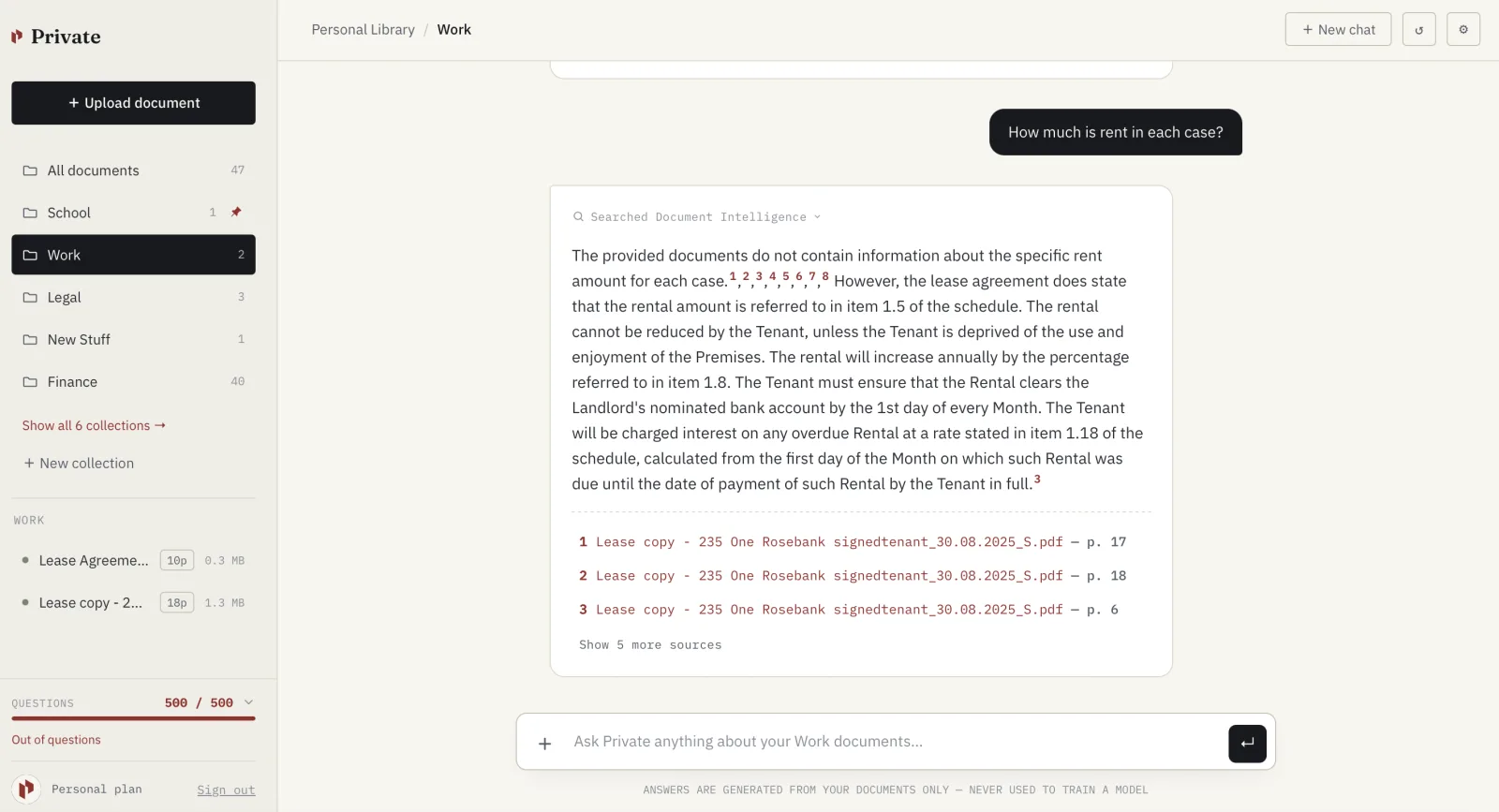
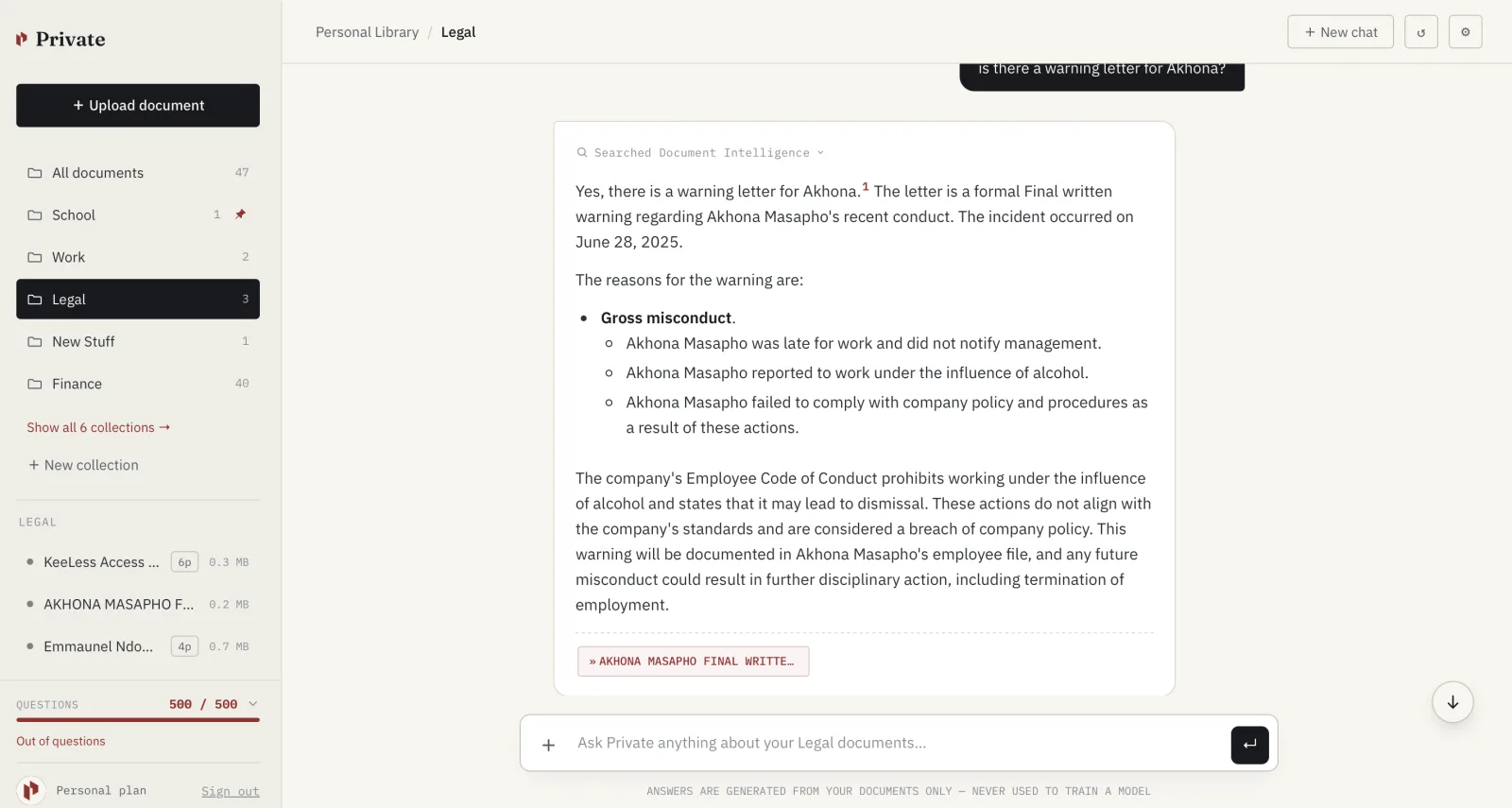
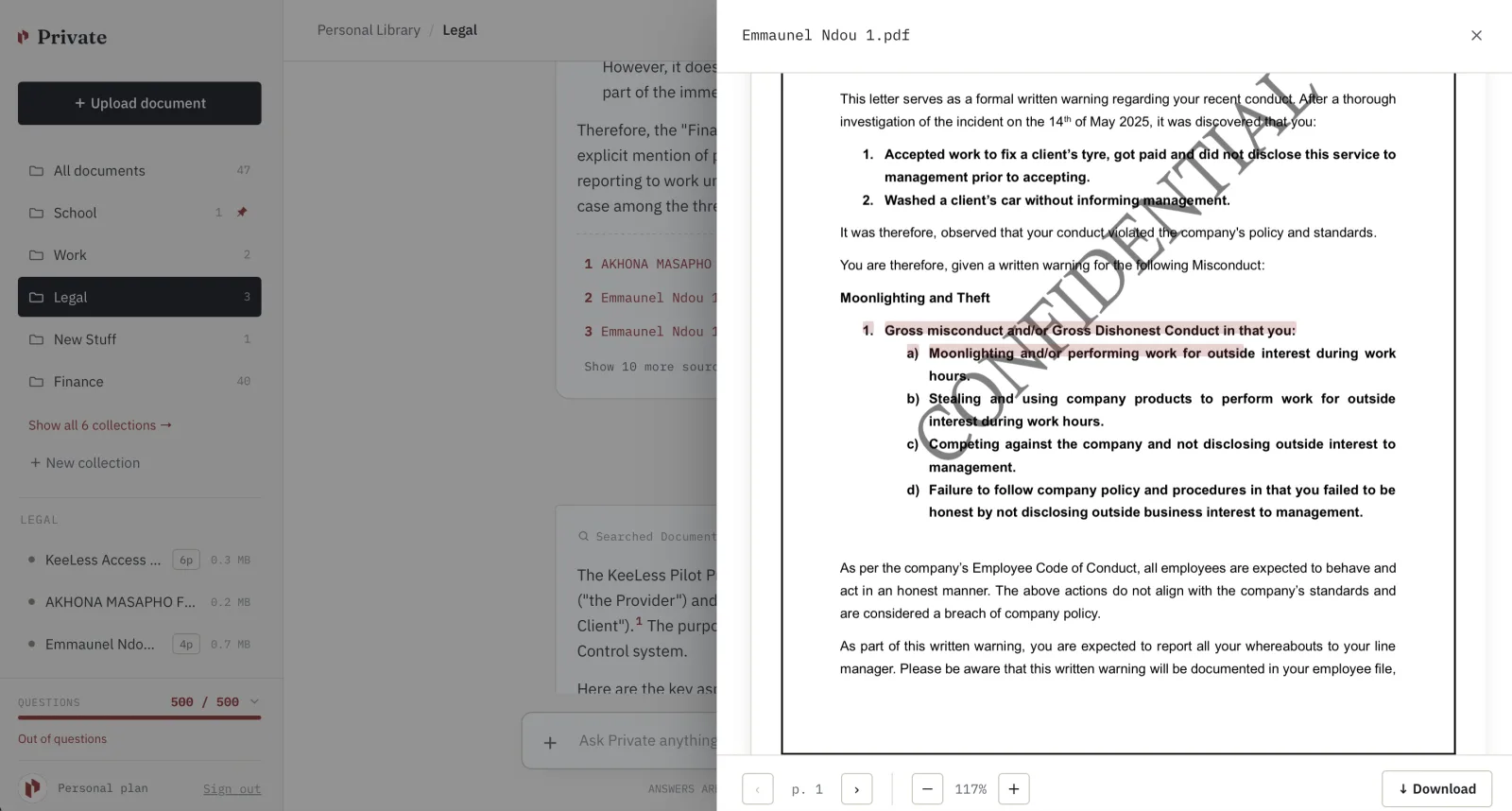
Private is easier to show than to describe. Upload a document, ask a question in plain language, and get a cited answer back — here's what that looks like:
Why we built it
It happens more than anyone likes to admit. A contract lands on your desk, 30 pages of dense language, and you're short on time. Pasting it into ChatGPT to summarise a clause feels like a harmless shortcut. It usually isn't.
When you paste text into a general-purpose AI chatbot, you're sending it to a system that may retain that input, may use it to improve the underlying model, and almost certainly wasn't built with client confidentiality in mind. Your client didn't consent to their contract being read by a third-party AI vendor. Most professionals know this is a problem, but the convenience wins because nothing better exists.
Private exists to remove that trade-off. It does one thing: you upload documents, ask questions in plain language, and get answers cited back to the exact page. Nothing else. That narrower scope is deliberate.
The problem it solves
Professionals who handle confidential documents — solicitors, paralegals, healthcare practitioners, freelance consultants — lose real hours every week hunting through documentation for one specific clause, date, or obligation. The alternative (pasting into ChatGPT) is faster but comes with risks most can't afford:
- No citation: general chatbots give you an answer with no way to verify where it came from.
- Training risk: your documents may be used to improve the model, depending on the plan and settings. That's not a hypothetical — it's the default behaviour of tools built for general use.
- Compliance exposure: under frameworks like POPIA, the responsible party remains your business even when a foreign AI tool does the processing. If something goes wrong, the inquiry starts with you.
What Private actually does
Private is not a workspace, not a general chatbot, and not a platform you need to configure. It does one job:
- Upload documents: contracts, case files, policies, reports, any PDF or office document.
- Organise into collections: keep each client, project, or topic in its own space so nothing gets mixed.
- Ask questions in plain language: "When does this lease renew?", "Is there a non-compete clause?", "What are the payment terms?"
- Get cited answers: every response points back to the exact document and page it came from, so you're never just trusting the AI.
That's it. It doesn't try to be your team's workspace. If that narrower scope is exactly what you want — nothing to configure, nothing extra to manage, one job done properly — Private is built for you.
Who it's built for
Private was shaped by conversations with people who handle confidential files as part of their daily work:
- Legal teams: sole practitioners, small firms, paralegals, and in-house counsel who need to search contracts, verify clauses, and cross-reference NDAs without scrolling through 40-page PDFs.
- Healthcare practices: solo practitioners and small clinics who need to look up protocols or reference correspondence without the exposure that comes with general AI tools and health data.
- Freelance consultants: independent professionals who keep each client's contracts in a separate collection so they can check deliverables, payment terms, and IP clauses without rereading the whole agreement.
Privacy as architecture, not a feature
Privacy isn't a setting you toggle on. It's the starting assumption the rest of the system is built around:
- Never used to train a model: that's a contractual guarantee, not a marketing claim. Private's infrastructure runs on enterprise-tier cloud AI terms that contractually prohibit using your documents to train or improve any model.
- Every answer cited: you can trace every response back to the exact page it came from. No hallucinated answers with no source to check.
- Instant deletion: deleting a document removes it immediately, not eventually. Access is revocable per collection, at any time.
- No data mixing: collections keep each client's or project's documents separate. Nothing leaks between them.
A privacy policy describes intent. A data processing agreement with a model-training prohibition is a contractual commitment you can point to. For anything genuinely confidential, you want the latter.
How it works under the hood
When you upload a document, Private indexes it, breaks it into chunks, and stores vector embeddings so it can find the right passages when you ask a question. When a question comes in, the system retrieves the most relevant chunks from your documents (Retrieval-Augmented Generation), feeds them to the language model as context, and generates an answer grounded in your actual files rather than generic training data. Every source passage is tracked so the citation can point back to the exact page.
The platform runs on Google Cloud enterprise infrastructure with Node.js handling the backend. Documents are processed and stored securely — the same infrastructure tier used by organisations with strict compliance requirements.
The honest tradeoff
Tools like Notion AI are more complete products if you want one tool for notes, docs, and AI together. Private is narrower on purpose. It doesn't do project management, wikis, or team collaboration. It does document Q&A with citations and privacy guarantees, and it does that well.
If you're looking for a workspace, Private isn't it. If you're looking for a place to ask your confidential documents questions without worrying about where that data ends up, that's exactly the gap it fills.
Where it stands
Private is live at askprivate.app. You can sign up for free, upload a document, and ask it something — no card required. The platform is built for professionals who handle confidential files: legal teams, healthcare practices, freelance consultants, and anyone whose documents deserve better than a general chatbot.
Try Private for free
Upload a document and ask it something you'd actually need to know. Every answer cited to the exact page, never used to train a model.
Try it free →Building something with strict data privacy requirements?
If your AI use case can't involve sending sensitive data to a third party, that constraint is exactly what we design around.
Talk Through Your Build